
The New Way Small Businesses Are Using AI to Close More Deals
🛍️ Products Mentioned (3)
💼 Want this built for your business: https://ryanandmattdatascience.com/crm-ai-yt 🚀 Get the free setup guide in our AI community: https://ryanandmattdatascience.com/skool-crm-ai If you're a freelancer or small agency, you're probably losing deals simply because you can't keep track of where everything is at. In this video, I walk through the AI agent system I built that connects directly to HubSpot, Gmail, and Google Docs — and lets me ask natural language questions about my pipeline right inside Slack. Ask it things like "What deals are stalling?", "When did I last speak to this person?", or "Did we send a proposal?" — and it figures out where to look, searches across your tools, and comes back with a clear answer. It also runs an insights pipeline automatically every day so you never miss something important, even when you forget to ask. I cover the full architecture, the n8n workflows that handle Slack and Gmail connectivity, the HubSpot MCP setup, the ReAct recursion framework, and a live demo of it running in real time. 🚀 Get the free framework in our AI Community: https://ryanandmattdatascience.com/skool-crm-ai 💼 Have us build this for your business: https://ryanandmattdatascience.com/crm-ai-yt Chapters in the timestamps above ⬆️ TIMESTAMPS 00:00 - The problem: losing deals without proper sales management 00:45 - What I built: AI agent for your CRM pipeline 01:08 - How it works: Slack, daily insights, natural language queries 02:00 - Tools connected: HubSpot, Gmail, Google Docs 02:30 - What you can ask it: follow-ups, stalling deals, last contact 03:29 - High-level architecture overview 04:38 - Insights pipeline: how it avoids repeating the same insights 05:46 - Query pipeline: plan generator and agent types 06:55 - HubSpot MCP server setup 08:08 - ReAct agent & recursion framework explained 09:20 - API structure and query format 10:21 - Why agent dependencies are critical to get right 11:24 - Result aggregation, sources & confidence scoring 12:24 - Live demo: running a query in Slack 13:36 - n8n workflow walkthrough (Slack trigger → API → response) 14:43 - Viewing the results in Slack 15:10 - Daily insights pipeline running automatically 15:54 - Customising your answer format with prompts 16:58 - Use cases: freelancers, small agencies, small sales teams 18:00 - Wrap up OTHER SOCIALS: 🌐 Website & Blog: https://ryanandmattdatascience.com/ Ryan’s LinkedIn: https://www.linkedin.com/in/ryan-p-nolan/ Matt’s LinkedIn: https://www.linkedin.com/in/matt-payne-ceo/ Twitter/X: https://x.com/RyanMattDS *This is an affiliate program. We receive a small portion of the final sale at no extra cost to you.
About This Video
Frequently Asked Questions
🎬 More from Ryan & Matt Data Science
How to Use Claude Cowork Connectors (Step-by-Step Tutorial)
377 views
How to Use Claude Cowork Scheduled Tasks (Step-by-Step Tutorial)
398 views
How I Built an AI Email Agent With Claude Cowork (No Code)
650 views
The Claude Cowork Feature That Generates Ideas for You
575 views
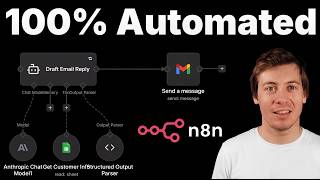
I Built an AI Email Assistant in n8n (Community Challenge)
363 views
How to Use Claude Cowork Projects (Step-by-Step Tutorial)
10.8K views