
Walking Water Experiment (Rainbow Walking Water)
🛍️ Products Mentioned (7)
Science Kits and more
Kids Fun Science Online Store
Cell Phone Tripod 54 inch Travel Tripod with Bluetooth Remote
Blue Yeti USB Microphone
Green screen & lights
Apple iMac 21.5in 2.7GHz Core i5 8GB memory
iPhone 8
Watch This! Water Mysteriously Travels Between Glasses Walking Water Experiment (Capillary Action) Get water to "walk" from one cup to another in this colorful science experiment. Fun & Easy experiment with Capillary action, the amazing, gravity-defying scientific phenomenon that causes liquids to flow up. Made for parents and teachers Hey, welcome back to Kids Fun Science! Made for parents and teachers, today we're showing a fascinating **science experiment** perfect for **science for kids** where **colored water** "walks" between glasses. Watch as **capillary force** makes the water travel, leading to exciting **mixing colors** and creating a vibrant display! Science Kits and more https://elementarysciencen.wixsite.com/sciencekits Kids Fun Science Online Store https://teespring.com/stores/kids-fun-science My Filming equipment: Cell Phone Tripod 54 inch Travel Tripod with Bluetooth Remote - https://amzn.to/34REzbB Blue Yeti USB Microphone - https://amzn.to/3ePJwGu Green screen & lights - https://amzn.to/2XT9Yc1 Apple iMac 21.5in 2.7GHz Core i5 8GB memory - https://amzn.to/34ZMIe7 iPhone 8 - https://amzn.to/3byn4zw iMovie for editing Chapters 0:00 Kids Fun Science Intro 0:22 What your need 0:33 Set up 1:56 Experiment 2:27 Science Behind it What you need 3 to 7 glasses of equal height (depends on what colors you want to use.) Water Food Coloring (Red, Blue, Yellow ) Paper Towel (I used Bounty) I used hot water and Bounty Paper towels (The quicker Picker upper) Kids can learn about how secondary colors are formed when the orange, green and purple colors are made in the empty cups and Capillary Action. Capillary effects involve two things: the surface tension of the liquid itself and the contact angle of the liquid on a solid surface. High surface tension means the liquid is capable of clinging strongly to itself. Low contact angle means good "wetting" of the surface by the liquid and maximizes the effectiveness of that pull. This means that high surface tension and low contact angle mean a high capillary draw up the paper towels. Now, as the temperature of water increases, the surface tension of the water diminishes. This makes it easier for attractive forces between water molecules and other surfaces in the vicinity to pull water into capillary crevices and pores in those surfaces and wet them out. This is why hot water does a better job rinsing dirt out of your clothes than cold water does: it reduces the contact angle between the water and the solid surfaces, enhancing the wettability of those surfaces. But note that if we reduce the surface tension of the water, we reduce the available pull force it can exert to drag itself up a vertical surface against gravity. So although the hot water wets that surface better, it cannot climb as far up that surface, and the capillary draw goes down in response. But lucky for us, we don't have to climb very far, so gravity is not going to be a problem for this experiment. We make up for this by agitating the surfaces in contact with the water while washing them, so as to assist the water to get in there and do its job. This is why we put agitators in washing machines. We can do much the same at room temperature by adding detergents to the water which "break" its surface tension without heat. Now it wets the surfaces like crazy. Capillary Action .....in Action! Without capillary action, the water level in all glasses would be the same. Even if you've never heard of capillary action, it is still important in your life. Capillary action is important for moving water (and all of the things that are dissolved in it) around. It is defined as the movement of water within the spaces of a porous material due to the forces of adhesion, cohesion, and surface tension. Capillary action occurs because water is sticky, thanks to the forces of cohesion (water molecules stay close together) & adhesion (water molecules are attracted & stick to other substances). Adhesion of water to the walls of a vessel will cause an upward force on the liquid at the edges and result in a meniscus which turns upward. The surface tension acts to hold the surface intact. Capillary action occurs when the adhesion to the walls is stronger than the cohesive forces between the liquid molecules. The height to which capillary action will take water in a uniform circular tube (picture to right) is limited by surface tension and, of course, gravity. Not only does water tend to stick together in a drop, it sticks to glass, cloth, organic tissues, soil, and, luckily, to the fibers in a paper towel. Dip a paper towel into a glass of water and the water will "climb" onto the paper towel. In fact, it will keep going up the towel until the pull of gravity is too much for it to overcome. #walkingwater #scienceexperiments #colorchangingwater #travelingwalkingwater #walkingwaterexperiment
🎬 More from Kids Fun Science (Kids Fun Science)
Music Inside Your Head? Testing the Viral Singing Lollipop!
96 views
How Many Hammer Hits to Knock a Potato Off a Stick?
105 views
Static Electricity Experiment Kids Are Obsessed With
951 views
Light diffraction glasses are insane - Holographic glasses
1.9K views

SQUARE VORTEX Air Cannon Experiment!
346 views
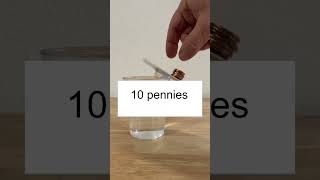
Stacking Pennies on Water Gets Crazy #satisfying #experiment #physics
5.5K views