
Running 700 Pounds of Gold Ore at the Mine: Mobile Milling and Smelting a Gold Button!
🛍️ Products Mentioned (3)
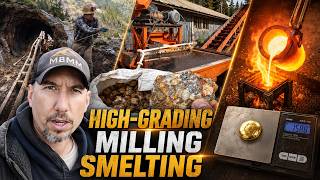
Back on the gold claim, we head deep into the workings to look at the quartz veins, old stopes, and underground structure that control where the gold is actually concentrated. Along the way, this video gives a practical look at hard rock gold geology, including how mineralized quartz veins form, why they are bounded by host rock, and why some parts of a vein can be rich while other sections are nearly barren. We also walk through the old underground workings and show the kinds of features historic miners followed, including steeply dipping quartz veins, wall rock contacts, mined-out stopes, and the dangerous hanging wall conditions that still make abandoned mines so risky today. Inside the mine, we examine old support methods, stacked waste rock, timber and wood stall support, rail haulage routes, and an ore transfer tunnel that once carried material out to the mill. One of the most interesting parts of the tour is a flat-lying section of the vein where the structure changes dramatically. That bend in the vein appears to be tied to a higher-grade zone, and sampling in this section has returned strong assay values that make it one of the most promising targets on the claim. It is a great example of how structure, dip changes, and vein geometry can make a major difference in gold distribution underground. After the underground tour, the focus shifts from geology to processing as we load up roughly 700 pounds of quartz float and run it through the truck mill system. The material goes through the hammer mill, across the sluice, and into concentrates, giving a real-world look at small-scale ore reduction and gold recovery in the field. Rather than just talking about ore grades and mine potential, this video shows the full process: collecting rock, crushing it, running it, checking the sluice, panning the concentrates, and seeing whether the time, fuel, and labor actually translate into recovered values. To finish the job, the concentrates are dried, smelted into a metallic button, and then cupelled to remove impurities and leave behind a cleaner precious metal bead. That final step gives a much better idea of what the quartz float was really carrying and helps put the grade into perspective. From underground vein exposure to milling, panning, smelting, and refining, this is an authentic look at real small-scale hard rock gold mining. If you are into underground mines, gold quartz, ore processing, vein geology, old mining methods, and the reality of chasing gold in historic workings, this video delivers the full story from rock in the ground to finished metal. #goldmining #geology #earthscience For more info please email or call: Email: info@MBMMLLC.com Phone: 360-595-4445 Website: http://www.mbmmllc.com/ eBay: https://www.ebay.com/usr/mtbakerminingandmetals Patreon: http://www.patreon.com/MBMMLLC Facebook: https://www.facebook.com/MBMMLLC Instagram: https://www.instagram.com/mbmmllc/ Twitter: https://twitter.com/MBMMLLC
🎬 More from mbmmllc
Getting the Mine Ready to Blast: We're Already On Gold! Season 1, Part 2
22.8K views
You Won’t Believe How Much Gold is in the Golden Griffin Ore! Season 2, Episode 6
74.3K views
I Bought A 125 Year-Old Gold Mine!! Season 1, Part 1
46.6K views
Crushing 1200+ Pounds of Ore from the Golden Griffin Mine! Season 2, Episode 5
64.8K views
Mining, Milling, and Smelting 1500+ Pounds of Gold Ore! Was It Worth It??
73.1K views
We Found a Hidden Adit to High Grade Gold at the Golden Griffin Mine! Season 2, Episode 4
80.5K views