
Crushing Ore the Old Timers Left Behind! Wait Until You See How Much Gold I Recovered!!
🛍️ Products Mentioned (3)
In this video, we head out to an old gold mining property that has recently been leased and begin the first serious round of testing on the ground. The focus of this trip is to sample the historic ore piles left behind by earlier miners, study the quartz vein underground, and start building a realistic picture of what this property might produce. Rather than guessing from surface appearances alone, the goal is to move bulk material, process it, recover the gold, and use those results to guide future mining plans. At the mine, the old workings reveal a broad quartz vein exposed inside a historic stope where the old-timers blasted and removed ore until operations stopped. The vein appears to average around 2 to 3 feet wide, pinching and swelling along its course, and lies in metamorphosed shale or slate wall rock. Mineralization includes iron sulfides in the quartz, with the gold typically associated with those sulfide-rich sections rather than the barren white quartz. According to the field observations and sampling, some of the material on the property shows promising grade, with certain piles and vein sections ranging from roughly 10 to 15 grams per ton and some estimates even higher depending on the zone being tested. After hauling down dozens of ore sacks for the season’s test work, the material is examined up close to separate quartz-rich ore from lower-value wall rock. From there, the ore is run through a 1 ton-per-hour turnkey processing system. The rock is first crushed down to gravel size, then fed through a hammer mill to further liberate the free-milling gold from the quartz. Once pulverized, the material goes across a shaker table where the heavy concentrates are separated and collected for final cleanup. The video walks through the entire recovery sequence, from bulk sampling and ore handling to table concentrates, panning, roasting, smelting, and cupelling. It shows not just the visible gold that can be panned quickly, but also the additional precious metal recovered from the panning tailings and higher-grade concentrates. That gives a much more realistic look at actual recovery instead of just the flashy visible portion. By the end of the test, the final recovered gold confirms that the ore run delivered solid values in the neighborhood of 10 to 15 grams per ton, making this a very encouraging first look at the potential of the old property. This is a practical hard rock gold mining video centered on real underground geology, real ore, and real recovery work. From the old stope and quartz vein underground to the final gold button on the scale, the video captures the full process of evaluating a historic mine for future production. It is both a field test and a proof-of-concept run, showing how small-scale miners can use bulk sampling, careful processing, and hands-on metallurgy to decide whether an old gold mine still has worthwhile ore left behind. For more info please email or call: Email: info@MBMMLLC.com Phone: 360-595-4445 Website: http://www.mbmmllc.com/ eBay: https://www.ebay.com/usr/mtbakerminingandmetals Patreon: http://www.patreon.com/MBMMLLC Facebook: https://www.facebook.com/MBMMLLC Instagram: https://www.instagram.com/mbmmllc/ Twitter: https://twitter.com/MBMMLLC #goldmining #geology #earthscience
🎬 More from mbmmllc
Getting the Mine Ready to Blast: We're Already On Gold! Season 1, Part 2
22.8K views
You Won’t Believe How Much Gold is in the Golden Griffin Ore! Season 2, Episode 6
74.3K views
I Bought A 125 Year-Old Gold Mine!! Season 1, Part 1
46.6K views
Crushing 1200+ Pounds of Ore from the Golden Griffin Mine! Season 2, Episode 5
64.8K views
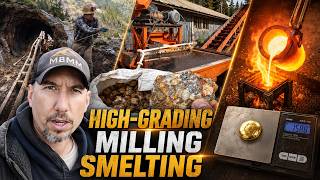
Mining, Milling, and Smelting 1500+ Pounds of Gold Ore! Was It Worth It??
73.1K views
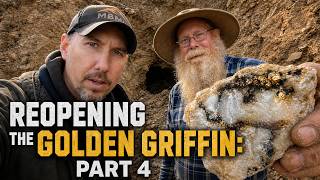
We Found a Hidden Adit to High Grade Gold at the Golden Griffin Mine! Season 2, Episode 4
80.5K views