
Design Spotify Recommendation Engine | How Music Recommenders Work? Scalable System Design
🛍️ Products Mentioned (12)

To get the Source Code, Follow me on GitHub
Bit Product
2. GenAI Full Course with LLM Fine Tuning and Evaluation

3. Learn RAG from scratch with GenAI projects
4. Latest AI/GenAI Research Papers Explained
5. RAG and LLM Use Cases in Finance Domain Projects
6. Prompt Engineering

7. Financial Data Analysis and Financial Modelling
8. Artificial Intelligence Projects
9. Predict IPL 2023 Winner (End-to-End Data Science Project)
10. Explainable AI (XAI) Machine Learning
11. Face Recognition
ml system design, machine learning system design, machine learning, system design, recommender systems, music recommendation engine, real-time ML systems, data pipelines, feature stores, ranking models, deep learning systems, scalable ML architecture, MLOps, AI system design, recommendation algorithms How Music Recommendation Systems Work | ML System Design Ever wondered how music streaming platforms recommend songs you’re likely to enjoy? 🎧 In this video, we break down the end-to-end design of a large-scale music recommendation system, focusing on architecture, data flow, and modeling decisions used in real-world ML systems. What You’ll Learn - How modern recommendation systems are structured - Problem formulation and requirement analysis - Offline vs online evaluation metrics - High-level system components: retriever, ranker, re-ranker - Common model architectures: - Two-Tower models - DeepFM - Transformer-based recommenders - Real-time data pipelines and batch processing - Feature stores, caching, and latency optimization - Cold-start challenges and mitigation strategies - Trade-offs between accuracy, scalability, and cost Why This Video Matters This is not theoretical ML — it’s a production-oriented system design explanation, focused on: - Scale considerations - Personalization pipelines - System constraints - Observability and reliability The goal is to help you think clearly about how large ML systems are designed and evolved over time. Tools & Frameworks Discussed - Kafka · Flink · Feature Stores · Vector Search - TensorFlow Recommenders · Airflow · Redis - Kubeflow · MLflow · Prometheus · Grafana 👉 Watch till the end for a discussion on hybrid recommendation approaches that balance explainability, performance, and maintainability. 💬 Comment below if you have questions 👍 Like | 🔄 Share | 🔔 Subscribe for more GenAI projects 📌 Source code & updates: GitHub → https://github.com/simranjeet97 ✍️ Read detailed blogs & project breakdowns on Medium: https://bit.ly/3JGXqwc Learning Playlists GenAI Agentic AI Course [14+ Agents] https://www.youtube.com/playlist?list=PLYIE4hvbWhsAkn8VzMWbMOxetpaGp-p4k GenAI Full Course with LLM Fine-Tuning & Evaluation https://bit.ly/4bJwZla Learn RAG from Scratch with GenAI Projects https://bit.ly/3Zl47KD Latest AI / GenAI Research Papers Explained https://bit.ly/4huqEMT RAG & LLM Use-Cases in Finance Domain https://bit.ly/3AGSRQm Prompt Engineering https://bit.ly/42v376M Financial Data Analysis & Modelling https://bit.ly/3OCWI5O Artificial Intelligence Projects https://bit.ly/3L8lhEi End-to-End Data Science Project https://bit.ly/3BfC3N9 Explainable AI (XAI) https://bit.ly/3gsuIxb Face Recognition Projects https://bit.ly/2YphpHm #MLSystemDesign #AIProjects #GenAI #AgenticAI #RAG #LLM #MLOps #AIEngineering #deeplearning Disclaimer: Made with ChatGPT, only for educational purposes.
About This Video
Frequently Asked Questions
🎬 More from FreeBirds Crew - Data Science and GenAI
![The DeepSeek OCR Paper [Explained] AI Can Now See Text Instead of Reading | Optical Compression](https://img.youtube.com/vi/-PJtCo3Nq4w/mqdefault.jpg)
The DeepSeek OCR Paper [Explained] AI Can Now See Text Instead of Reading | Optical Compression
748 views
![Build 9 End-to-End GenAI Projects before 2025 [ RAG + Agentic AI + LLMs ] Scalable System Design](https://img.youtube.com/vi/M9p5zAYDgL4/mqdefault.jpg)
Build 9 End-to-End GenAI Projects before 2025 [ RAG + Agentic AI + LLMs ] Scalable System Design
40.8K views
![GenAI Roadmap [Ultimate AI Roadmap] 2025 | From GenAI LLMs RAG Agentic AI | Future Ready Guide](https://img.youtube.com/vi/4yZ7mp6cIIg/mqdefault.jpg)
GenAI Roadmap [Ultimate AI Roadmap] 2025 | From GenAI LLMs RAG Agentic AI | Future Ready Guide
2.9K views
![Squid Game X AI [Red Light, Green Light] | Machine Learning System Design + Computer Vision](https://img.youtube.com/vi/YWWB4wesKjw/mqdefault.jpg)
Squid Game X AI [Red Light, Green Light] | Machine Learning System Design + Computer Vision
754 views
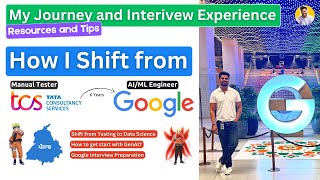
TCS to Google | From Manual Tester to Machine Learning Engineer | Punjab to FAANG | Tier 3 to GenAI
85.4K views
![Netflix ML System Design [Explained] Video Recommendation System | Retriever Ranker Models](https://img.youtube.com/vi/0aqbVJKFNtI/mqdefault.jpg)
Netflix ML System Design [Explained] Video Recommendation System | Retriever Ranker Models
1.6K views