
Reid Pauly book event — The Art of Coercion: Credible Threats and the Assurance Dilemma
The Art of Coercion presents a fresh explanation for the success—and failure—of coercive demands in international politics. Strong states are surprisingly bad at coercion. History shows they prevail only a third of the time. Reid B. C. Pauly argues that coercion often fails because targets fear punishment even if they comply. In this “damned if you do, damned if you don’t” scenario, targets have little reason to obey. Pauly illustrates this logic in nuclear counterproliferation efforts with South Africa, Iraq, Libya, and Iran. He shows that coercers face an “assurance dilemma”: When threats are more credible, assurances not to punish are less so. But without credible assurances, targets may defy threats, bracing for seemingly inevitable punishment. For coercion to work, as such, coercers must not only make targets believe that they will be punished if they do not comply, but also that they will not be if they do. About the Author Reid Pauly is Assistant Professor of Political Science and the Dean’s Assistant Professor of Nuclear Security and Policy at Brown University’s Watson School of International and Public Affairs. He studies nuclear proliferation and nuclear strategy, coercion, and secrecy in international politics. Pauly is the author of The Art of Coercion: Credible Threats and the Assurance Dilemma (Cornell University Press, 2025). His scholarship has also been published in International Security, International Studies Quarterly, the European Journal of International Relations, and Foreign Affairs. Pauly earned his Ph.D. from MIT and has held fellowships at the Harvard Kennedy School’s Belfer Center for Science and International Affairs, Stanford University’s Center for International Security and Cooperation, the Schmidt Futures International Strategy Forum, and Dartmouth College’s Dickey Center for International Understanding. Moderator Rose McDermott, Director of Postdoctoral Program, David and Marianna Fisher University Professor of International Relations Panelists Charles Glaser, MIT Security Studies Program. Stacie Goddard, Betty Freyhof Johnson ’44 Professor of Political Science, Wellesley College Kelly Greenhill, Associate Professor of Political Science, Associate Professor, Tufts University
🎬 More from Watson School of International and Public Affairs
Social media, the attention economy and the health of American democracy with Chris Hayes
267 views
The Great Divide: A Conversation with Chris Hayes ’01
1.1K views
Does the US really make the dollar? Has it ever?
986 views
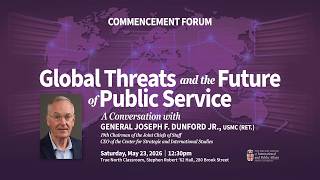
Commencement Forum: Global Threats and the Future of Public Service
124 views

The war in Iran’s ripple effect on the global energy economy
367 views
The war in Iran’s ripple effect on the global energy economy
184 views