Lightning You Can Hold
🛍️ Products Mentioned (1)
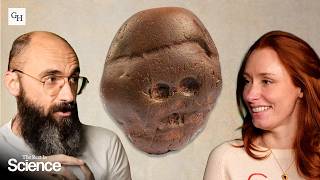
Could a bolt of lightning become a permanent geological relic? How small would you have to squash a hamster to turn it into a black hole? Professor Hannah Fry and Michael Stevens dismantle our perceptions of scale and texture, moving from the glassy "fulgurites" forged in sandy soil to the mathematical threshold of the Schwarzschild radius. They explore the counter-intuitive geometry of the Earth, calculate the extreme density required to collapse domestic life into a gravitational singularity and examining the crystalline remains of atmospheric discharge. This is an investigation into the smooth, the sharp, and the impossibly dense, proving that the world we touch is rarely as it seems. ------------------- For more information about Cancer Research UK, their research, breakthroughs and how you can support them, visit https://www.cancerresearchuk.org/our-research/rest-is-science?utm_source=therestisscience&utm_medium=podcast&utm_campaign=goalhanger_podcast_partnership Cancer Research UK is a registered charity in England and Wales (1089464), Scotland (SC041666), the Isle of Man (1103) and Jersey (247). A company limited by guarantee. Registered company in England and Wales (4325234) and the Isle of Man (5713F). Registered address: 2 Redman Place, London, E20 1JQ. ------------------- Video Editor: Adam Thornton + Oli Oakley Video & Social: Bex Tyrrell Assistant Producer: Imee Marriott Producer: Becki Hills Senior Producer: Lauren Armstrong-Carter Head Of Digital: Samuel Oakley Exec Producer: Neil Fearn ------------------- 00:00 Intro 00:45 Why do mirrors flip us horizontally but not vertically? 04:38 Cancer Research UK 05:47 How dense would a hamster have to be to become a black hole? 11:00 If the earth was shrunk down to the size of a pool ball, is it true it would be smoother than any man made object? 17:30 Hannah’s fulgurites 28:12 Outro