
This $50 AC You Can Make At Home Fast and Easy!
🛍️ Products Mentioned (8)
1/4" Copper Refrigeration Tubing (50ft roll) — the hero component
Capillary Tube 0.031" ID (100ft roll) — the 50¢ part that makes it all work
12V DC Air Pump (acts as the compressor)
Isobutane Fuel Canister (the refrigerant)
12V 80mm Cooling Fan (pushes air across the evaporator)
Schrader Valve Core Kit (for charging the refrigerant circuit)
Propane Brazing Torch Kit (for sealing copper joints)
Infrared Thermometer (verify your coil hits sub-zero temps)
Stop overpaying for cooling! Learn how a simple $5 copper coil can drop temperatures by 40° using 1834 physics. ❄️ Ever wonder why your central AC costs $7,000 while the science behind it hasn't changed since the 19th century? In this video, I’m stripping back the curtain on the HVAC industry to show you how to build a high-performance DIY air conditioner using basic hardware store materials. We’ll dive into the Pressure Drop Effect, the history of Jacob Perkins’ 1834 patent, and why the "big industry" fought to keep cheap refrigerants like Isobutane out of your home. Whether you are prepping for a power outage, living off-grid, or just tired of massive utility bills, this sketchy survival hack is a game-changer. I’ll explain why copper coils outperform aluminum every time and how a 50-cent capillary tube is actually the "brain" of the entire cooling cycle. This isn't just a science project; it's a portable, survival cooling solution that fits in a shoebox. 🛠️ BUILD COMPONENTS ▶1/4" Copper Refrigeration Tubing (50ft roll) — the hero component https://amzn.to/4296IZU ▶ Capillary Tube 0.031" ID (100ft roll) — the 50¢ part that makes it all work https://amzn.to/4dQLh7i ▶ 12V DC Air Pump (acts as the compressor) https://amzn.to/41xemgD ▶ Isobutane Fuel Canister (the refrigerant) https://amzn.to/4cqGreB ▶ 12V 80mm Cooling Fan (pushes air across the evaporator) https://amzn.to/4vnBpIi ▶ Schrader Valve Core Kit (for charging the refrigerant circuit) https://amzn.to/4mwYrs4 ▶ Propane Brazing Torch Kit (for sealing copper joints) https://amzn.to/4sxs3Hh ▶ Infrared Thermometer (verify your coil hits sub-zero temps) https://amzn.to/3QbxdeQ ⚠️ SAFETY: Isobutane is flammable. Keep the system away from open flames and spark sources, work in a ventilated space, and keep your charge under 100 grams. Millions of European refrigerators have run on isobutane safely for 30+ years — treat it like the camping gas it is. Timestamps: 0:00 – The $5 Copper Coil vs. The $25 Billion Industry 0:27 – Understanding the Pressure Drop Effect 1:34 – Why Isobutane (Camp Fuel) is the Ultimate Refrigerant 2:23 – Jacob Perkins and the 1834 Refrigeration Secret 3:08 – Copper vs. Aluminum: Why Material Science Matters 5:00 – Building the Evaporator: The "8-Wrap" Rule 6:06 – The Capillary Tube: The Key to Sub-Zero Temps 8:17 – How the HVAC Industry Protected Their Profits 10:00 – Final Assembly: 12V Off-Grid Cooling 12:05 – Critical Safety Protocols & Handling Isobutane Support My Work & Stay Sketchy: If you found this useful, don’t forget to LIKE the video and SUBSCRIBE to join my survival journey. It helps me keep the lights on and the experiments running! 🔗 Subscribe to My Channel: https://www.youtube.com/@SketchySurvival101?sub_confirmation=1 📸 Follow My Instagram: https://www.instagram.com/sketchysurvival 🎵 Catch Me on TikTok: https://www.tiktok.com/@sketchysurvival101 #SketchySurvival #DIYAC #OffGridCooling #SurvivalHacks #HVACSecrets #HomemadeAirConditioner #RefrigerationCycle #DIYSurvival #EnergyEfficiency #Isobutane #CopperCoil #SustainableLiving #EmergencyPrep #DIYProject #scienceexperiments SOURCES (rest in pinned comment) 1. Jacob Perkins vapor-compression refrigeration patent (1834) - British Patent No. 6662, August 14, 1834 - Source: International Institute of Refrigeration (IIR) historical records - Described closed-cycle vapor-compression system using diethyl ether 2. Thermal conductivity of copper vs aluminum - Copper: ~398 W/m·K at room temperature - Aluminum: ~237 W/m·K at room temperature - Source: CRC Handbook of Chemistry and Physics; Engineering Toolbox reference tables 3. Isobutane (R-600a) boiling point - -11.7°C (10.9°F) at 1 atmosphere (101.325 kPa) - Source: NIST Chemistry WebBook, Standard Reference Database 4. Isobutane adoption timeline — Europe vs United States - 1993: Greenfreeze initiative in Germany demonstrated R-600a as viable household refrigerant - European manufacturers adopted immediately through 1990s-2000s - 2008: Underwriters Laboratories (UL) approved R-600a for domestic refrigerators in the US - Source: Greenpeace International Greenfreeze campaign records; UL certification history 5. ASHRAE 34 classification of isobutane - R-600a classified as A3 (low toxicity, high flammability) - Domestic refrigerator charge amounts: 50-150 grams - Source: ASHRAE Standard 34-2022, Designation and Safety Classification of Refrigerants 6. US HVAC industry market size - Approximately $25-30 billion annually (equipment market) - Source: Grand View Research; Fortune Business Insights market reports (2024-2025) 7. Average US household cooling costs - National average: approximately $200-250/year (12% of total home energy expenditure) - Hot climate states (AZ, TX, FL): $400-700+/year - Source: US Energy Information Administration (EIA), Residential Energy Consumption Survey (RECS)
🎬 More from Sketchy Survival

This $200 Wood Gas Generator Powered a Million Cars in WWII (Science Explained)
207 views

This $500 Iron Battery Still Works After 100 Years.
907 views
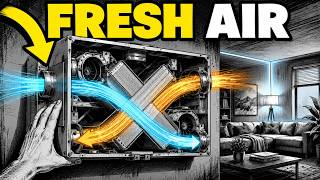
This $200 Box Brings Fresh Air And Cuts Your AC Bill FOREVER. Why Don't Builders Use It?
1.1K views

This $200 Creek Turbine Makes Free Power 24/7 FOREVER. So Why Did We Stop?
401 views

This $100 Engine Runs On A Candle FOREVER (Physics Explained)
529 views

Why 80°F Can Kill You But 100°F Won't (The Humidity Trap)
371 views