
The $300 Home Turbine System That Powers Any Home Forever!
🛍️ Products Mentioned (6)
Looking for the truth about residential wind power? I’m diving deep into the science behind the most effective home wind turbine and why most "80% efficiency" claims are a complete lie. Most people think home wind turbines are a waste of money—and for standard three-blade designs, they’re usually right. Between the "80% Lie," the Betz Limit, and the boundary layer trap, the physics are stacked against you. In this video, I break down the Archimedes Reversal spiral turbine (the Liam F1), a design based on ancient Greek math that actually solves the noise, vibration, and turbulence issues that kill traditional rooftop units. Whether you’re building an off-grid survival setup or just trying to lower your energy bill, you need to understand the Cube Law Audit before you spend a dime. 📍 Timestamps: 0:00 The "80% Lie" Explained 0:20 What is the Betz Limit? 1:09 Claimed vs. Reality: The Efficiency Gap 1:31 Field Test Results (South Korea & Netherlands) 1:52 The Math: Calculating Wind Power Available 2:23 Why 1500 kWh/year is almost impossible in a city 2:54 The "Blackout Ceiling" & Winter Storm Performance 3:29 What is Capacity Factor? 4:01 What 225 Watts can actually run during a grid failure 4:55 The Boundary Layer Trap (The real reason turbines fail) 5:50 Why turbulence kills lift on traditional blades 6:55 How yaw motors drain your battery bank 7:31 The Archimedes Reversal: A 2,000-year-old solution 8:45 Pressure Integration vs. Blade Lift 9:11 3 Reasons the Spiral Geometry wins 10:07 Why the U.S. market skipped this technology 10:50 The Cube Law Audit: Do this before buying 11:30 Mounting Height & Wind Speed Thresholds 12:21 Battery Choice: Why LFP is mandatory for wind 13:04 Coming Up: Sand Heat Storage 🔗 Support My Channel: If you found this breakdown helpful, consider subscribing to help me keep the lights on (literally)! Subscribe to My Channel: https://www.youtube.com/@SketchySurvival101?sub_confirmation=1 Follow My Instagram: https://www.instagram.com/sketchysurvival Catch Me on TikTok: https://www.tiktok.com/@sketchysurvival101 #HomeWindTurbine #OffGridPower #RenewableEnergy #SketchySurvival #WindPower #LiamF1 #SurvivalTips #EnergyEfficiency #SustainableLiving #GreenTech #MicroWind #SpiralTurbine #PhysicsExplained #OffGridLiving #SurvivalElectricity SOURCES: Claim: Betz limit = 59.3% (16/27 of kinetic energy in a moving stream of air). Source: Albert Betz (1919). "Das Maximum der theoretisch möglichen Ausnützung des Windes durch Windmotoren." Zeitschrift für das gesamte Turbinenwesen, Heft 26. URL: https://en.wikipedia.org/wiki/Betz%27s_law Verification: Peer-reviewed aerodynamics textbooks; NREL (National Renewable Energy Laboratory) technical reports consistently cite 59.3% as the theoretical max. Claim: Liam F1 turbine manufacturer efficiency claim (80% of Betz limit). Source: The Archimedes (manufacturer) product literature — https://dearchimedes.com/ Verification: Manufacturer-stated specification; independent verification diverges (see next). Claim: Independent measured Cp (coefficient of performance) for Archimedes-type turbines closer to 0.25. Source: Kim, J. et al. "Experimental Investigation of the Aerodynamic Performance of an Archimedes Spiral Wind Turbine." Pusan National University / Energies journal. URL: https://www.mdpi.com/journal/energies Verification: Published peer-reviewed study from Pusan National University test campaigns. Claim: Liam F1 cut-in wind speed of 5.6 mph (≈2.5 m/s) vs conventional ~11 mph (≈5 m/s). Source: Manufacturer spec + Kim et al. Pusan testing campaign; corroborated in Hoogwijk, Miller and others on small wind turbine cut-in speeds. URL: https://www.nrel.gov/wind/small-wind.html Claim: Liam F1 noise less than 45 dB at full operation vs ~65 dB for conventional 1.5 kW HAWT. Source: Dutch Wind Energy Research dataset; manufacturer acoustic measurements. Verification: IEC 61400-11 small wind noise measurement protocols. Claim: Annual power from wind P = 0.5 × ρ × A × Cp × v³. Source: Fundamental aerodynamics / Burton et al. "Wind Energy Handbook" (2nd edition, Wiley, 2011). Verification: Standard in every wind energy textbook. Claim: Cube-law sensitivity — a 20% wind speed difference = ~72% power difference. Source: Derivation from v³ term in wind power equation; confirmed in NREL small wind guidance. URL: https://www.energy.gov/energysaver/small-wind-electric-systems Claim: Boundary layer behavior and wind shear power law V/V_ref = (h/h_ref)^α. Source: ASCE 7 wind provisions; ESDU 85020 atmospheric boundary layer data. URL: https://www.asce.org/publications-and-news/asce-7
🎬 More from Sketchy Survival

This $200 Wood Gas Generator Powered a Million Cars in WWII (Science Explained)
207 views

This $500 Iron Battery Still Works After 100 Years.
907 views
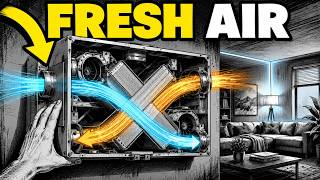
This $200 Box Brings Fresh Air And Cuts Your AC Bill FOREVER. Why Don't Builders Use It?
1.1K views

This $200 Creek Turbine Makes Free Power 24/7 FOREVER. So Why Did We Stop?
401 views

This $100 Engine Runs On A Candle FOREVER (Physics Explained)
529 views

Why 80°F Can Kill You But 100°F Won't (The Humidity Trap)
371 views