
The $1 Powder That Repels ALL Insects FOREVER. This Is Why They Hid It!
Stop wasting money on bug spray! Discover the $1 fossil algae powder that destroys insects forever. Tired of chemical bug sprays that vanish in 90 minutes? In this video, I reveal the hidden solution the pesticide industry buried back in 1960. This $1 powder made from fossilized algae—known as Diatomaceous Earth—doesn't just repel insects; it physically destroys them on contact. I’ll break down the three physics principles that make this powder the ultimate sketchy survival tool for your home and garden. We’ll explore why traditional repellents like DEET only block one out of four insect targeting stages and how the "shred and drain" cycle ensures pests can never develop resistance. Whether you're dealing with bed bugs, cockroaches, or ants, I’ll show you how to build a permanent "Perimeter Shield" for pennies. This is the natural pest control secret you need for your survival kit! Timestamps: 0:00 The $1 Fossil Algae Secret 0:46 How Insects Target You (The 4 Stages) 1:43 Why Your Current Bug Spray is Failing 3:37 The "Shred and Drain" Cycle Explained 5:15 Why Pests Can't Develop Resistance 6:42 Building the "Perimeter Shield" Around Your Home 7:59 One Bag, Infinite Uses (Pets, Garden, & Storage) 8:54 The Final Verdict: Spray vs. Powder 9:41 Sneak Peek: The $7 AC Power Hack Stay Connected: Subscribe for more Sketchy Survival: https://www.youtube.com/@SketchySurvival101?sub_confirmation=1 #DiatomaceousEarth #PestControl #SurvivalTips #SketchySurvival #NaturalRepellent #InsectHack #BugSpray #Homesteading #GardenHacks #BudgetSurvival #DIYPestControl #BedBugSolution #AntKiller #Survivalist #HomeDefense #InsectPrevention #BugHack #naturalliving SOURCES 1. McMeniman CJ, Corfas RA, Matthews BJ, Ritchie SA, Vosshall LB. "Multimodal Integration of Carbon Dioxide and Other Sensory Cues Drives Mosquito Attraction to Humans." Cell, 2014. PMC4007582. — Used for: mosquito CO2 detection at 50 meters, four-stage targeting system 2. Cator LJ, Wyer CAS, Harrington LC. "Thermal infrared directs host-seeking behaviour in Aedes aegypti mosquitoes." Nature, 2024. — Used for: infrared heat detection from ~70cm, doubled host-seeking behavior 3. Zeni V, Baliota GV, Benelli G, Canale A, Athanassiou CG. "Diatomaceous Earth for Arthropod Pest Control: Back to the Future." Molecules, Volume 26, Issue 24, December 2021. PMC8706096. — Used for: DE mechanical killing mechanism, no resistance development, kill times, efficacy data 4. National Pesticide Information Center (NPIC). "Diatomaceous Earth General Fact Sheet." Oregon State University / EPA. — Used for: EPA registration (1960), 150+ registered products, food-grade GRAS status, mechanism of action, insect species list 5. US EPA. "DEET" fact sheet and registration information. — Used for: DEET evaporation rate (~10%/hour), temperature effect on protection duration 6. Leal WS. "The enigmatic reception of DEET — the gold standard of insect repellents." Current Opinion in Insect Science, 2014. PMC4269249. — Used for: DEET mechanism of action (olfactory confusion), development history (Army 1946, public use 1957) 7. US FDA. 40 CFR 180.1017 — Exemption from food tolerance requirements for silicon dioxide/diatomaceous earth. — Used for: food-grade DE safety, 2% in food as anticaking agent 8. US Department of Defense. DoD Insect Repellent System — permethrin-treated uniforms. — Used for: military uniform treatment, contact killing vs repelling effectiveness 9. US Army. "MilTICK study finds use of permethrin-treated uniforms can reduce tick-borne illness risk." Army.mil, 2023. — Used for: military confirmation that contact killing outperforms repelling 10. Grand View Research. "Insect Repellent Market Size, Share & Trends Analysis Report." 2024. — Used for: $5.57 billion US insect repellent market size 11. Statista. "Usage of insect repellent in the United States." 2020. — Used for: 195.5 million Americans use insect repellent annually 12. HomeGuide / Angi. Professional pest control cost data, 2025-2026. — Used for: average professional pest treatment cost ($2,300) 13. CDC. "About Mold — Basic Facts." Centers for Disease Control and Prevention. — Used for: general indoor humidity recommendations (below 50%)
🎬 More from Sketchy Survival

This $200 Wood Gas Generator Powered a Million Cars in WWII (Science Explained)
207 views

This $500 Iron Battery Still Works After 100 Years.
907 views

This $200 Box Brings Fresh Air And Cuts Your AC Bill FOREVER. Why Don't Builders Use It?
1.1K views

This $200 Creek Turbine Makes Free Power 24/7 FOREVER. So Why Did We Stop?
401 views

This $100 Engine Runs On A Candle FOREVER (Physics Explained)
529 views
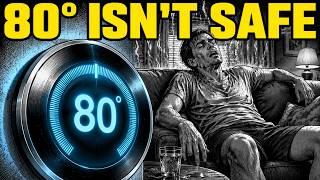
Why 80°F Can Kill You But 100°F Won't (The Humidity Trap)
371 views