
Pneumothorax: Definition, Types and classification Preview
🛍️ Products Mentioned (2)
Pneumothorax is a collection of air in the pleural cavity between the visceral and parietal pleura resulting into loss of the normal negative sucking pressure in the pleural cavity causing partial or complete lung collapse. Get a detailed pneumothorax lecture notes on our site as https://medcrine.com/pneumothorax From respiratory physiology, the visceral pleura is the one that lines the lungs and the parietal pleura lines the chest wall and there exists a potential space in between with a negative pressure known as pleural cavity. In pneumothorax, air can enter this pleural space as the result of lung disease or injury. Types of pneumothorax Pneumothorax is classified based on the cause as spontaneous or traumatic pneumothorax. Spontaneous pneumothorax can be also further classified as · Primary spontaneous pneumothorax when there is no any clinically underlying lung disease or · Secondary spontaneous pneumothorax when it happens as a complication of an underlying lung disease. A recurrent pneumothorax is a second episode of spontaneous pneumothorax that can either be ipsilateral (on the same side) or contralateral (opposite side). Traumatic pneumothorax is a type of pneumothorax that is caused by a penetrating trauma such as a penetrating gunshot wound, stab injury or surgical mistake on the chest cavity. Tension pneumothorax on the other hand is a life-threatening variant of pneumothorax that is characterized by progressively increasing positive pressure within the chest and cardio-respiratory compromise. It is of importance to know that; tension pneumothorax can result from any type of pneumothorax. Epidemiology Primary spontaneous pneumothorax occurs more commonly in thin, tall athletic men in a ration of 6male :1female. It has a peak incidence between 20–30 years of age. Secondary spontaneous pneumothorax occurs more in males too than female but at a smaller ratio of 3:1. It has a peak incidence of 60–65 years of age. Causes of pneumothorax Spontaneous pneumothorax is caused by; Primary causes with no underlying lung pathology (idiopathic or simple pneumothorax) Ruptured subpleural apical blebs of bullae. Risk factors The risk factors for development of primary pneumothorax are: Family history Young, tall and thin male gender Asthenic body of a slim and tall stature Marfan syndrome and Homocystinuria Smoking is the most common preventable cause Secondary pneumothorax as noted in the classification occurs as a complication of underlying lung disorder. The most common risk factors for its development are; Chronic obstructive pulmonary disease (COPD) is the most common common cause. Smoking leading to a rupture of bullae in emphysema Cystic fibrosis Pulmonary tuberculosis Pneumocystis pneumonia with a rupture of a cavity Lung cancer/malignancy Catamenial pneumothorax Traumatic pneumothorax Traumatic pneumothorax is caused by either a blunt or penetrating trauma. A blunt trauma such as an impact to the thorax that causes a rib fracture Penetrating injury like a stab wound or a gunshot wound Iatrogenic pneumothorax results from the treatment modality being applied to the patient such as barotrauma secondary to mechanical ventilation with a high positive end expiratory pressure (PEEP), lung biopsy, thoracocentesis, bronchoscopy of insertion of a central venous catheter. Pathophysiology of pneumothorax Pneumothorax occurs when there is an increased intrapleural positive pressure contrary to the normal negative pressure that usually pulls the lungs out and preventing collapse. In this case of an increased intrapleural pressure there is a consequential lung and alveolar collapse which leads to a decreased ventilation perfusion(V/Q) ratio and increased right-to-left shunting of blood. In spontaneous pneumothorax where there is a rupture of blebs or bullae, air moves into pleural space from within the lung increasing positive pressure in the pleural cavity. The ipsilateral lung is then compressed and collapses leaving the unaffected lung. There is no diaphragm shift downwards or tracheal shifting in this case. SUBSCRIBE, LIKE and SHARE Check our website for more medical lecture notes at https://medcrine.com Follow us on twitter @medcrine Facebook at www.fb.me/medcrine Pinterest at pinterest.com/medcrine Telegram at t.me/medcrine email us on info@medcrine.com
🎬 More from Medcrine

Anticoagulants: Heparin Mechanisms, Clinical Use, and Monitoring and Clinical Insights
1.2K views

Antidepressants Pharmacology | SSRIs, SNRIs, TCAs, MAOIs, Atypical Antidepressants Simplified
1.0K views
Down syndrome (Trisomy 21) - causes, symptoms, diagnosis, & pathology
376 views
Anencephaly Explained | Neural Tube Defect | Medical and Nursing High-yield Tutorial
1.2K views
Achondroplasia | Causes, Pathophysiology, Symptoms, Diagnosis, and Management Simplified
959 views
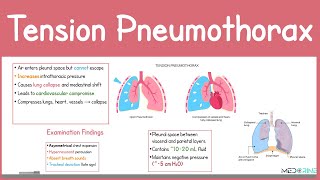
Tension Pneumothorax: Pathophysiology, Clinical signs & Symptoms, Diagnosis and treatment Explained
580 views