
Creating "Depth" for Comic Artists Part 2 of 2 on Perspective for Illustration - Pat Quinn Artist
🛍️ Products Mentioned (7)
Slides on Patreon
Trenton Charity Comic Con
Patreon Product
Cryptopia on Zoop
* Comic Book School Patreon
* Deanna Destito Patreon
* Mike Fasolo's Substack
Continuing our series on Perspective for Comic Artists, we explore how the illusion of depth works and how comic book artists can create visual perspective on the page. Slides on Patreon: https://www.patreon.com/ComicBookSchool/posts/creating-depth-2-160795408 Part 1: How to Draw Perspective: https://youtube.com/live/R39bVq0x0o0 Trenton Charity Comic Con: https://trentoncharitycomiccon.com/ https://www.patreon.com/c/ComicBookSchool We analyze the technical art mechanics of creating depth and drawing perspective with professional comic book artist and professor Pat Quinn! In Part 2 of our perspective series, hosts Buddy Scalera and Mike Fasolo break down how artists build a three-dimensional illusion on a flat, two-dimensional page using geometric logic, camera placement, and lines of convergence. Quinn—veteran artist of Gen 13, Green Lantern, and the creator-owned series Cryptopia—joins the panel to actively mark up a double-page spread from his upcoming work. We evaluate the mechanics of ground planes, horizon lines, and advanced architectural elements, while unpacking critical industry vocabulary that every professional storyteller needs to master. KEY EDUCATIONAL TAKEAWAYS The Ground Plane: How a structured perspective grid anchors your characters and backgrounds, ensuring every object sits on a believable three-dimensional floor. Horizon Line & Eye Level: Understanding how the placement of your camera's eye level dictates the vertical real estate and height distortion of an environment. Station Point & Camera Lenses: How the distance of the viewer from an object determines focal length tightness and prevents layout distortion. Advanced Architectural Terms: Master the use of orthogonals (lines of convergence) and fenestration (the deliberate layout of window patterns) to accurately build scenery. The Gutter Imperative: Crucial technical rules for designing two-page spreads, ensuring critical narrative beats and dialogue elements never get lost in the book's center binding. Link: Pat Quinn Instagram: https://www.instagram.com/pqcomics/ Cryptopia on Zoop: https://zoop.gg/c/cryptopia DATE: 6/9/2026 TIME: 8:00 PM EST HOST: Buddy Scalera CO-HOST: Mike Fasolo CO-HOST: Deanna Destito GUEST: Pat Quinn, comic artist Q: How do comic book artists create the illusion of three-dimensional depth on a flat page? A: Artists build depth by establishing a clear geometric ground plane using a perspective grid. By structuring the scene with a designated horizon line (eye level) and plotting lines of composition toward vanishing points, the brain accepts flat layers as foreground, middle ground, and background spaces. Q: What are orthogonals and fenestration in comic art? A: Orthogonals are the physical lines of convergence drawn by an illustrator that trace directly back to an established vanishing point. Fenestration is a precise architectural layout term that describes the calculated, structured alignment and arrangement of window patterns on a building's facade. Q: What is the main rule for layout artists when drawing a two-page spread? A: The most critical technical rule is to never place vital narrative or dialogue elements in the exact center of the spread. Because binding formats vary (such as saddle-stitching), anything drawn directly inside the center crease or "gutter" runs a high production risk of being pinched or entirely lost to the reader. Q: What is a station point in illustration perspective? A: The station point represents the absolute physical placement of the viewer or "camera lens" in relation to the scene. Altering the station point dictates how tight or wide the focal lens behaves, directly changing how closely grouped your vanishing points sit and how aggressively the lines of composition converge. YOUTUBE CHAPTERS 05:30 - Defining Perspective: Creating Space on a Flat Surface 06:45 - Breaking Down Advanced Vocabulary: Orthogonals and Fenestration 08:00 - Live Spread Marking: Laying out Compositional Planes 09:30 - Eye Level Masterclass: Moving Horizon Lines and Station Points 12:15 - Technical Pitfalls: Navigating the Gutter on a Two-Page Spread 15:00 - MC Escher Illusions: Constructing Mind-Bending Mindfields SOCIAL LINKS * Comic Book School Patreon: https://www.patreon.com/comicbookschool * Deanna Destito Patreon: https://www.patreon.com/cw/deannadestito * Mike Fasolo's Substack: https://mikefasolo.substack.com
🎬 More from Comic Book School - Buddy Scalera & Mike Fasolo
Mike Marts (Editor in Chief, Mad Cave Studios) Talks What Editors Do - Distilled version!
13 views
Lovern Kindzierski (Hellblazer, Shame, Fables) on Coloring Comics, Reading Scripts & Writing SHAME!
56 views
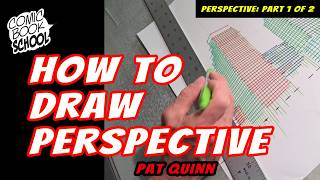
How to Draw Perspective - Pat Quinn Demonstrates Linear Perspective & Compositional Planes
512 views
Creator Gabbie Benda (Serendipity YA Graphic Novel) Reveals the Inspiration Behind the Characters
100 views
20 Comic Pros on What They Are Reading, Watching, & Listening To - Live #RWL
1.4K views
How Indie Horror Comics Get Made - Jonathan Chance on Writing, Artists & Creating Fear!
85 views