Is this your channel?
Diversity Fund Student Registration Fee Award
Diversity Fund Student Registration Fee Award
If we want to honor Turner’s legacy, we have to make sure more people get access to the spaces where science happens. The Animal Behavior Society’s Diversity Fund Student Registration Fee Award is a practical way to reduce barriers so underrepresented students can participate and be seen at professional events.
Pros
- +Helps reduce financial barriers to conference participation
- +Supports diversity and representation in behavioral science
Cons
- -Limited to eligible applicants and available funding
What Barbara Heidenreich says
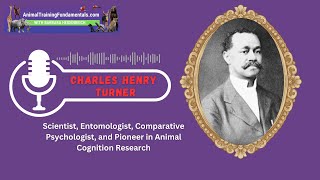
“hey everyone welcome to look what you've done the brand new podcast Series in the animal training fundamentals catalog and let me tell you this one is special why because this series is all about celebrating impact the goal here Ria relate illuminate and activate we're going to relate to the incredible stories of others illuminate their contributions and activate by giving you tangible steps to keep pushing our industry forward because let's be real progress doesn't happen by accident it happens because of people who refuse to back down I'm your host Barbara heyen Reich and I am beyond thrilled to take you on this journey and today we are kicking things off with a story you need to hear we're diving into the remarkable life of Charles Henry Turner a scientist whose work shaped what we know about animal learning and cognition today and yet his name is rarely mentioned in the history books why well we're about to get into that Turner wasn't just an entomologist he was an innovator a Pioneer in comparative psychology and a firm believer that even the tiniest creatures could learn problem solve and adapt and he was doing this at a time when he faced immense societal barriers so let's get to know Charles Henry Turner shall we now throughout history we've seen people who push boundaries people who refuse to accept that's just the way things are Charles Henry Turner was one of those people born in 1867 in Cincinnati Ohio Turner grew up in a world that didn't make it easy for African-Americans to pursue science let alone lead in the field but that didn't stop him he graduated as valid Victorian of his high school went on to earn his bachelor's and master's degrees at the University of Cincinnati and eventually became one of the first African-Americans to earn a PhD in Zoology from the University of Chicago in 1907 now here's where things get frustrating despite his groundbreaking research Turner was repeatedly denied positions at Major research universities let's be real racial barriers are a thing instead he spent most of his career teaching High School science a position that while no was Far Below his credentials but did he let that stop him no way Turner kept pushing forward conducting experiments in his spare time and Publishing over 70 scientific papers that's right 70 if that's not dedication I don't know what is then here's what makes his work so amazing at a time when many scientists believed insects were just little reflex driven machines Turner proved them wrong he showed that ants bees and even cockroaches could learn remember and adapt one of my favorite Turner experim exp his work with honeybees you guys he designed intricate experiments using colored discs to prove that bees could distinguish colors and patterns he even used schedules of reinforcement yes reinforcement schedules to remove potential confounds like scent detection this was revolutionary because it challenged the idea that insect Behavior was purely instinctual cool right but wait there's more Turner was also one of the first scientists to demonstrate pavlovian conditioning in insects he showed that moths could learn to associate a sound with an upcoming event think about that at a time when people thought learning was reserved for higher animals he was proving that even moths could form associations and then there were the ants oh the ants Turner wanted to know do they just rely on instinct or can they actually learn to navigate complex environments so he set up a maze yes an ant maze with a reinforcement at the end peie because you know ants love their pey and and guess what the ants didn't just blindly wander they learned the route remembered it and adjusted when Turner changed the layout that's spatial memory that's that's learning that's Turner being decades ahead of his time oh and let's not forget the Cockroaches Turner created an experiment with a two compartment chamber one side dark which cockroaches love and one side bright but here's the kicker when the roaches entered the dark side they got a mild electric shock over time they learned to avoid the dark side even though it went against their natural preference and some of them remembered this for 21 days that's long-term memory folks in a cockroach these studies laid the groundwork for modern insect Behavior research and yet um how many people know Turner's name well today you do and that matters now let's talk action because look what you've done isn't just about looking back it's about moving forward Turner's story reminds us that science isn't just about knowledge it's about who gets to participate in the discovery of knowledge so how do we keep breaking barriers here are a few ways support organizations that promote diversity in science the animal behavior Society offers A diversity fund student registration fee award and the applied animal behavior special interest group has a diversity award donate to scholarships and grants for underrepresented scientists consider contributing to funds like the Charles Henry Turner award by the animal behavior society which support students from underrepresented backgrounds in Behavioral Science invest in businesses led by minority science and Educators buy their books attend their courses share their work advocate for representation in conferences and Publications nominate diverse voices for speaking engagements and Leadership positions let's make sure everyone gets a seat at the table mentor and uplift emerging professionals if you've got the experience share it be the mentor you wish you had engage with the work of scientists like Turner read it share it keep the Legacy alive I'll put all these resources in the show notes for easy access turn Legacy isn't just about what he discovered it's about the doors he opened and the ones we need to keep pushing open thank you for tuning into this inaugural episode of look what you've done if you love this story share it spread the word and don't forget to subscribe so you never miss an episode let's keep recognizing all the voices that have shaped animal behavior and training because we're not going anywhere and neither is their impact until next time keep pushing boundaries keep learning and keep making a difference if you liked what you heard today visit animal trining fundamentals”
Curated by
Barbara Heidenreich